Do Not Disturb Funny Prankster
- 4.6
- Rating
- 50.00M
- Installs
- Free
- Price
 Analysis by App-foxy
I spent time with Do Not Disturb Funny Prankster as a light educational game from Tapps Games, and my first impression was clear: this is designed for quick, playful interaction rather than deep strategy or a long-form adventure. The central idea is simple—approach a neighbor’s door, experiment with a prank, and enjoy the reaction—but the appeal depends heavily on whether you like repeating small comic discoveries.
That simplicity is also its strongest selling point. I can open it when I have only a few minutes, understand the basic goal quickly, and start tapping without learning a complicated control scheme. It is free to download, rated for Everyone, and works on devices running Android 8.0 or later. The game has been available since June 27, 2013, so it is an established title rather than a brand-new experiment.
How the prank-based gameplay feels in everyday use
The game works best when I treat it as a short amusement instead of a conventional educational course. Its educational category may suggest lessons, quizzes, or structured learning, but the experience is more about observation, timing, and trying playful interactions. I learn by noticing what happens after each action, then remembering which approach produces a satisfying response.
You May Also Like

 Blood Strike: 2.5 Anniversary
Blood Strike’s Loadouts Turn Every Drop Into a Tactical Gamble
A close look at Blood Strike’s custom loadouts: how fast access to signature weapons reshapes its battle royale rhythm, rewards preparation, and narrows the gap between fights.

 Pandora - Music & Podcasts
Pandora’s Music Is Easy to Start, but Harder to Recover
Pandora’s strength is its low-effort path from a seed to a station. Its weak spot is how much confidence it asks you to place in connection, setup, and quiet recovery.

 8 Ball Pool
 Is Built on Rivalries, Rematches, and Routine
A close look at the rivalries, rematches, shared routines, and unanswered safety questions that turn a quick pool match into a persistent mobile community.

 Samsung Music
’s Quiet Strength Is Playing What You Already Own
Its reach comes less from spectacle than from dependable access to a personal library. That simplicity is both the app’s strongest retention engine and its ceiling.

 AccuWeather: Weather Radar
AccuWeather Review: A Quick, Clear Forecast for Everyday Decisions
For everyday plans, the best forecast is the one you can understand quickly. AccuWeather makes rain timing, radar, and local conditions easy to act on, with a few trade-offs.

 Hill Climb Racing
Why Hill Climb Racing Still Turns Crashes Into One More Run
A tiny car, a bumpy hill and one more upgrade: Hill Climb Racing keeps resurfacing because its simple chaos makes every near-miss feel personal.
More From Our News Desk



A realistic use case is a short break between tasks. If I am waiting for a bus or taking a few minutes away from work, I can play without committing to a long session. The neighbor-at-the-door setup gives each interaction an immediate purpose, while the humorous tone keeps the pressure low. It is especially easy to hand to a child who wants something interactive, although younger players may still benefit from an adult checking the device’s purchase settings.
What I like is that the game does not ask me to master complicated movement or manage a large inventory. The focus stays on the prank scenario. That makes the first few minutes approachable, but it also means the experience may feel thin to anyone expecting detailed puzzles, character development, or a substantial story.
One useful habit is to slow down rather than tapping everything immediately. In this kind of game, the fun comes from connecting an action with a reaction. I found that treating each attempt as a small experiment made the humor more rewarding than simply rushing through the available interactions. This is a modest but important difference: the game is more enjoyable when I play curiously, not when I treat it like a speed challenge.
What makes the interaction work
The neighbor theme gives the game a clear frame for its jokes. Instead of presenting unrelated mini-games, it places the player in a recognizable situation and lets the comedy come from disturbing an ordinary doorstep routine. That makes the title easy to explain to someone else: you are playing the prankster, and the door is the stage.
I also found that its short-session structure suits shared play. A parent, sibling, or friend can watch an attempt and suggest another idea without needing to understand a complicated backstory. This makes it more social than many solitary educational games, even though the core interaction remains simple. It can work as a conversation starter, particularly for children who enjoy predicting reactions.
There is a trade-off, though. Because the basic premise is so narrow, the novelty depends on how many different interactions the player finds and how much amusement they get from repeating them. Players who need constant progression may quickly ask what comes next. Players who enjoy small comic surprises are more likely to appreciate the compact format.
My practical advice is to play in short bursts and avoid judging it by the standards of a full puzzle game. It is not at its best when I expect a complex campaign. It is at its best when I want a harmless, silly distraction with a clear objective and a playful tone.
Progress, repetition, and the feeling of pressure
Progress in a prank game can feel different from progress in a traditional educational title. Instead of measuring success only through correct answers, I am motivated by discovering reactions and understanding what the game allows me to do. That creates a gentle form of experimentation, but it may not satisfy players who want visible mastery, formal stages, or a strong sense of achievement.
The pressure comes less from difficult controls and more from repetition. Once I understand the basic rhythm, the question becomes whether the next interaction will feel fresh enough to justify another attempt. This is where personal taste matters. I enjoyed returning briefly, but I would not recommend it as someone’s only game if they want a constantly changing challenge.
For children, that repetition can have a positive side. It encourages them to look at cause and effect, remember outcomes, and try a different choice instead of giving up after one result. I would describe that as informal learning rather than academic instruction. It is playful reasoning, not a replacement for a reading, mathematics, language, or science app.
For adults, the same loop is more likely to work as a nostalgic or comic diversion. I would not install it expecting a serious brain-training system. Compared with a dedicated puzzle app, it offers less structured problem solving. Compared with a standard quiz game, it offers more room for playful observation and less emphasis on right-or-wrong knowledge.
A good workflow is to let a child play independently for a few minutes, then ask what they expected to happen and what actually happened. That turns a simple prank into a small discussion about prediction and consequences. The game itself stays light, but the conversation around it can make the experience more thoughtful without forcing it to become a lesson.
Spending, fairness, and what I would watch
The download is free, while in-app purchases range from $0.49 to $9.99 per item. That makes the initial decision easy: I can try the game without paying upfront and decide whether its style suits me. The more important question is whether I feel comfortable with optional spending during play, especially when a child is using the device.
I would set a purchase restriction before handing the game to a child. That is not a criticism unique to this title; it is simply sensible whenever a free game includes paid items. The price range means a small accidental purchase and a more substantial one are not the same risk, so I would avoid leaving payment confirmation entirely in a child’s hands.
On fairness, I would separate two ideas. First, the game is not presented to me as a competitive multiplayer contest, so there is no obvious player-versus-player ranking pressure shaping the experience. Second, free-to-play design can still create pressure if progress or enjoyment becomes tied to purchases. I did not treat the existence of purchases alone as proof of unfairness, but I would pay attention to whether the free portion remains comfortable for the intended player.
My spending rule is simple: try the free experience first, then pay only for a clearly understood reason. If the game already provides enough amusement without buying anything, there is no need to spend merely because an item is available. If a child is asking for a purchase, I would make the decision outside the excitement of the moment and explain what the payment is meant to add.
This is also where the game differs from paid educational alternatives. A one-time purchase can feel easier to budget because the cost is decided before play, while a free game with item purchases asks the player to manage that boundary over time. On the other hand, the free entry point is useful for families who want to test the tone and suitability before committing money.
Is it fair compared with other games?
Compared with competitive games, the prank format is naturally less concerned with winning against other people. I am not choosing it for leaderboards, ranked matches, or a demanding skill ladder. Its fairness is better judged by whether the free interactions remain enjoyable and whether purchases feel optional rather than necessary.
Compared with educational apps built around lessons, Do Not Disturb Funny Prankster is more relaxed and less measurable. A child looking for spelling practice, arithmetic drills, or curriculum-linked exercises would be better served by a dedicated learning app. Here, the educational value comes from experimenting with actions and reactions, not from a structured syllabus.
Compared with traditional puzzle games, it is more accessible but potentially less demanding. That makes it a good choice for a younger player or someone who wants comic interaction without frustration. It is a weaker choice for a player who wants increasingly difficult logic problems, carefully balanced levels, or a long-term mastery curve.
Compared with a fully paid casual game, its free installation lowers the barrier to trying it, but the presence of in-app purchases adds a layer of spending awareness. I would choose it when I value immediate access and a playful premise. I would choose a paid alternative when I prefer a clearly defined cost and a more predictable progression model.
Important unknowns before installing
There are a few questions I would keep in mind without pretending to answer them with guesses. The listed information confirms the purchase range, but it does not tell me how often purchase prompts appear or exactly what each item changes. I would therefore inspect the purchase screen carefully and avoid assuming that every paid option is necessary.
The same caution applies to long-term depth. The game’s premise and established release history make its identity clear, but they do not automatically tell me how much variety I will find after repeated sessions. My recommendation is to treat the free download as a trial of the humor and interaction style, not as a promise of an extensive campaign.
Device compatibility is straightforward for Android users because the minimum requirement is Android 8.0. Before installing on an older phone or tablet, I would check the operating system rather than relying on the device’s age alone. That small check prevents an avoidable installation problem.
The age rating of Everyone makes the game broadly approachable, but an age label is not a substitute for supervision. I would still watch how a particular child responds to the prank theme and explain that the game’s fictional mischief is different from bothering real neighbors. That distinction is especially useful because the central joke is built around playful disturbance.
What the audience response suggests
The game has an average rating of 4.6 from around 232 thousand ratings, along with about 11 thousand written reviews. It has also passed 50 million installs. Those figures tell me that the concept has reached a large audience and that many players find the format appealing, but popularity does not remove the personal question of whether I enjoy repetition and simple prank-based humor.
I read that broad response as a reason to try the game, not as a guarantee that it will suit everyone. A highly rated casual title can still disappoint someone who wants detailed educational content or demanding puzzles. In my case, the strong audience response makes sense because the premise is immediately understandable and easy to sample.
The current version is 1.4.141, which is useful to check when troubleshooting or comparing the installed build with the version described in the app store. I would keep the game updated through the normal store process, particularly if an interaction behaves unexpectedly, but I would not assume that an update changes the basic character of the experience.
Who should install it, and who should skip it
I would recommend it to players who enjoy short comic games, children who like cause-and-effect interactions, and families looking for something easy to understand together. It is also a reasonable choice for someone who wants a free first try before deciding whether the style deserves more time or optional spending.
I would be more cautious if the main goal is formal education. The educational label should not be mistaken for a complete learning program. A child needing practice in a specific school subject would benefit more from an app built around that subject, with clear exercises and measurable progress.
I would also skip it if I strongly dislike repeated interactions, prank humor, or free-to-play purchase prompts. Even a well-liked game can become irritating when its central joke does not match my taste. Someone seeking a rich story, competitive play, or advanced strategy should choose a different category entirely.
For parents, the best approach is to try it first, check the purchase controls, and decide whether the tone fits the child. For adults, I would treat it as a compact novelty rather than a major time investment. That expectation makes the free entry point feel more valuable and keeps the limitations from becoming a surprise.
My trust verdict after playing
My overall view is positive but deliberately modest. Do Not Disturb Funny Prankster succeeds because it understands its own basic appeal: a familiar doorstep, a mischievous action, and a funny reaction. I found it easy to start, suitable for short sessions, and more interesting when I approached each interaction as a small experiment.
Its limitations are just as clear. It is not a substitute for structured education, it may not provide enough depth for dedicated gamers, and its in-app purchase range means adults should take a moment to manage spending before sharing the device. The free price makes trying it low-risk, but responsible use still matters.
Tapps Games has built a game with a broad audience, a Everyone rating, and a tone that can work for casual family play. I would recommend installing it when you want harmless, interactive comedy and are comfortable judging the experience on that scale. I would not recommend it as a primary learning tool or as a serious long-term challenge.
My final recommendation is to try the free version with expectations set correctly: look for quick amusement, playful observation, and small discoveries rather than a full educational curriculum or competitive progression system. If that sounds like the kind of break you want, this neighbor’s door is worth knocking on.
FAQs for Do Not Disturb Funny Prankster
01What is the main objective of Do Not Disturb Funny Prankster?
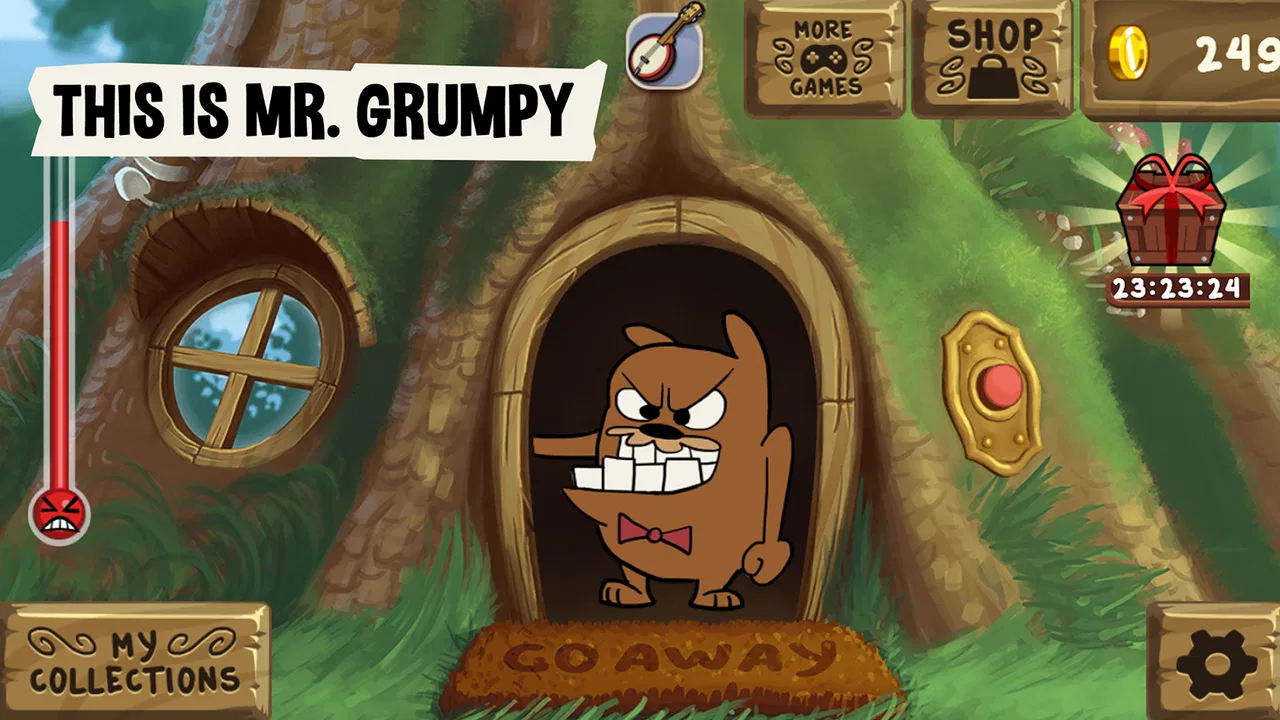
Do Not Disturb Funny Prankster is a lighthearted and entertaining app designed to provide users with humorous pranks and interactions. The main objective is to prank a virtual character, Mr. Grumpy, by ringing his doorbell or knocking on his door. Each interaction triggers a funny reaction or scene, making it a delightful way to pass the time.
02Is Do Not Disturb Funny Prankster suitable for all ages?
Yes, Do Not Disturb Funny Prankster is suitable for all ages. The app is designed to be family-friendly, with no inappropriate content. Its playful pranks and cartoonish animations make it enjoyable for kids and adults alike, providing a safe and humorous experience for everyone.
03Does the app require an internet connection to work?
Do Not Disturb Funny Prankster can be enjoyed both online and offline. While an internet connection may be required for initial downloads or updates, you can play the game without connectivity. This makes it convenient for users to enjoy the app anywhere, without worrying about data usage.
04Are there any in-app purchases or ads in Do Not Disturb Funny Prankster?
Yes, the app includes both in-app purchases and ads. While the basic gameplay is free, you can purchase additional content or remove ads for a small fee. Ads are integrated into the app, but they are generally non-intrusive, allowing for an enjoyable user experience.
05How can I download Do Not Disturb Funny Prankster on my device?
To download Do Not Disturb Funny Prankster, visit the Google Play Store for Android devices or the Apple App Store for iOS devices. Search for the app by name, and click on the download button. Ensure your device meets the minimum system requirements for a smooth installation and gameplay experience.
Pros
- Easy to use with intuitive controls.
- Offers a variety of hilarious pranks.
- Vibrant graphics enhance fun.
- Regular updates with new content.
- No internet required for gameplay.
Cons
- Contains ads that can be intrusive.
- Limited free pranks without purchase.
- No multiplayer or online features.
- Some pranks may repeat often.
- Sound effects can be loud.

Do Not Disturb Funny Prankster
Gallery